Classical cepheids
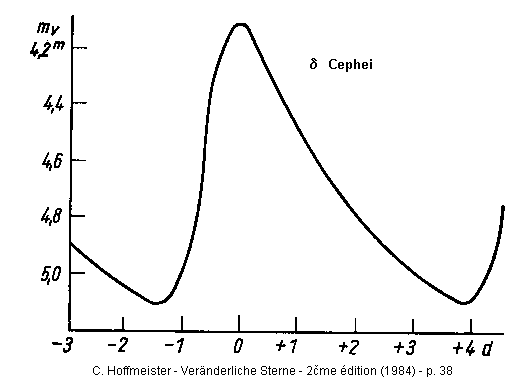
These are the classical cepheids, or Delta Cep-type variables. Com-
paratively young objects that have left the main sequence and
evolved into the instability strip of the Hertzsprung-Russell
(H-R) diagram, they obey the well-known Cepheid period-luminosity
relation and belong to the young disk population. DCEP stars are
present in open clusters. They display a certain relation between
the shapes of their light curves and their periods.
- DCEPS - These are Delta Cep variables having light amplitudes <0.5 mag in
V (<0.7 mag in B) and almost symmetrical light curves (M-m
approx. 0.4 - 0.5 periods); as a rule, their periods do not exceed
7 days. They are probably first-overtone pulsators and/or are in
the first transition across the instability strip after leaving
the main sequence (SU Cas).
Traditionally, both Delta Cep and W Vir stars are quite often called
Cepheids because it is often impossible to discriminate between
them on the basis of the light curves for periods in the range 3 -
10 days. However, these are distinct groups of entirely different
objects in different evolutionary stages. One of the significant
spectral differences between W Vir stars and Cepheids is the
presence, during a certain phase interval, of hydrogen-line
emission in the former and of Ca II H and K emission in the
latter.
Return to the page "pulsating variables"
Return to the page "typology"
Return to the AFOEV home page
Let us know your comments